01 · One chain

The terminal, the contract, the fiscal receipt and the settlement line are one system.

You are not running an integration project across five suppliers and hoping they agree on what a merchant is. There is one record of the merchant, and everything downstream reads it.

02 · One instance

Vendor → ISO → partner → merchant is in the data model, not in a copy of the system.

The hierarchy and the permissions are native. Nobody spins up a separate instance per tenant, so a sub-partner is a row — not a deployment.

// What the platform is made of

Acquire. Onboard. Deploy.
Support. Analyse. Grow.

The merchant lifecycle, and the module that carries each part of it. Every partner uses a different subset — nothing here is reserved for one kind of partner.

Underneath all six

Veslo Cloud

The device-facing backbone and the single record of what happened.

Platform APIs

Core, ISO, Partner, Vendor and Merchant services over GraphQL, one permission model.

Veslo Auth

One identity across every portal and application in the chain, with SDKs.

Permissions & roles

Per-resource, per-possession access that survives an audit.

Public API & developer portal

Documentation, sandbox and API keys for third-party systems.

Webhooks & live streams

Durable delivery with replay, plus SSE and WebSocket channels.

Notifications

Templated email, mobile push and event-triggered rules.

White-label theming

Partner brand colours and logo across portals and applications.

System administration

Cross-tenant administration and configuration.

// Platform · Onboarding

From a company name
to a signed contract.

Six steps that collect everything the contract needs — and never ask for it twice.

Click a step to see the screen
01

Configured to your requirements

Every acquirer collects something different. Steps, fields, documents and validation rules are configured per partner — the merchant is only asked for what you need.

02

Onboarding data lands in your systems

We push completed applications into the acquirer's or provider's own systems over API — merchant records arrive where your teams already work, not as an export someone re-keys. Each connection is scoped with the partner.
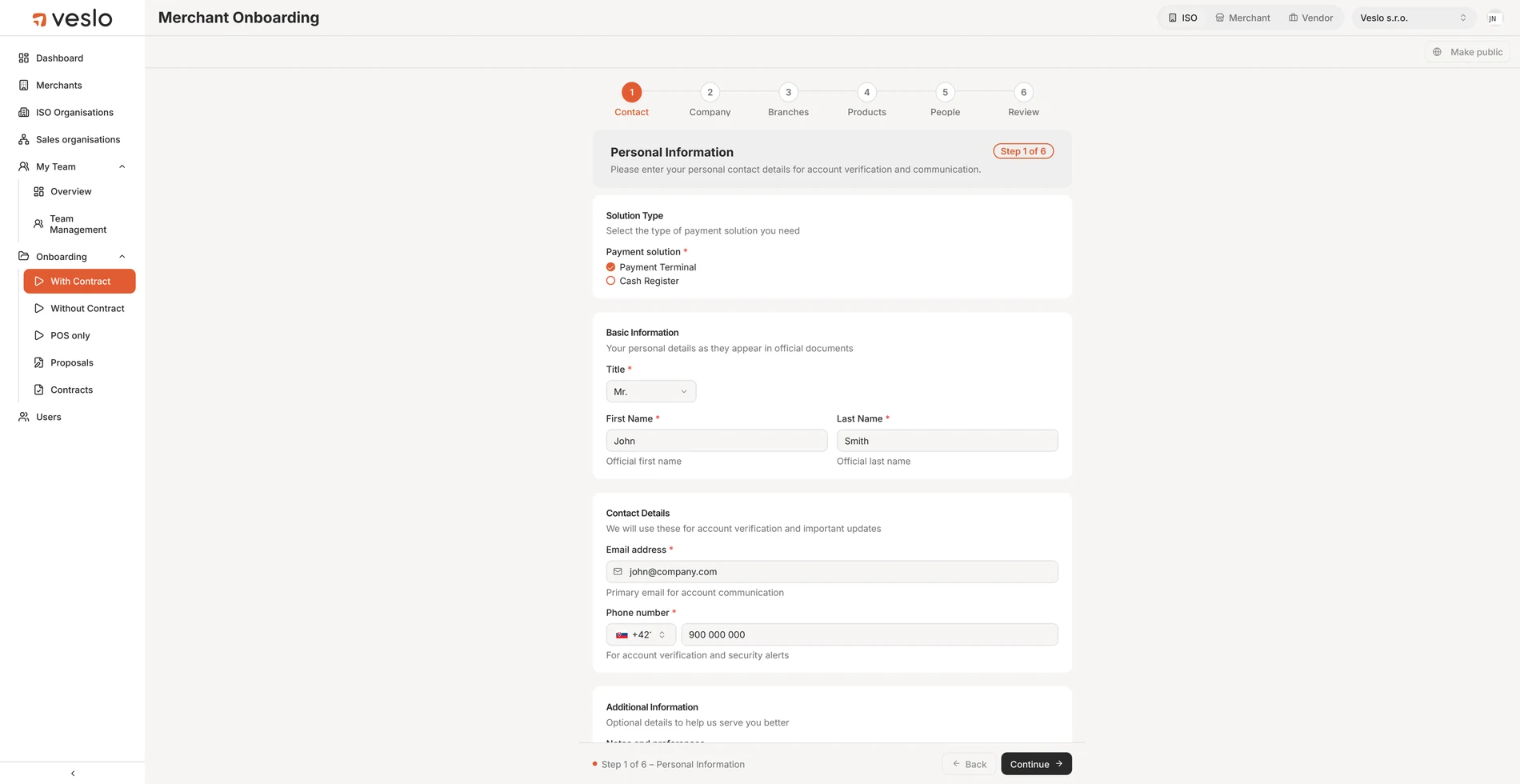
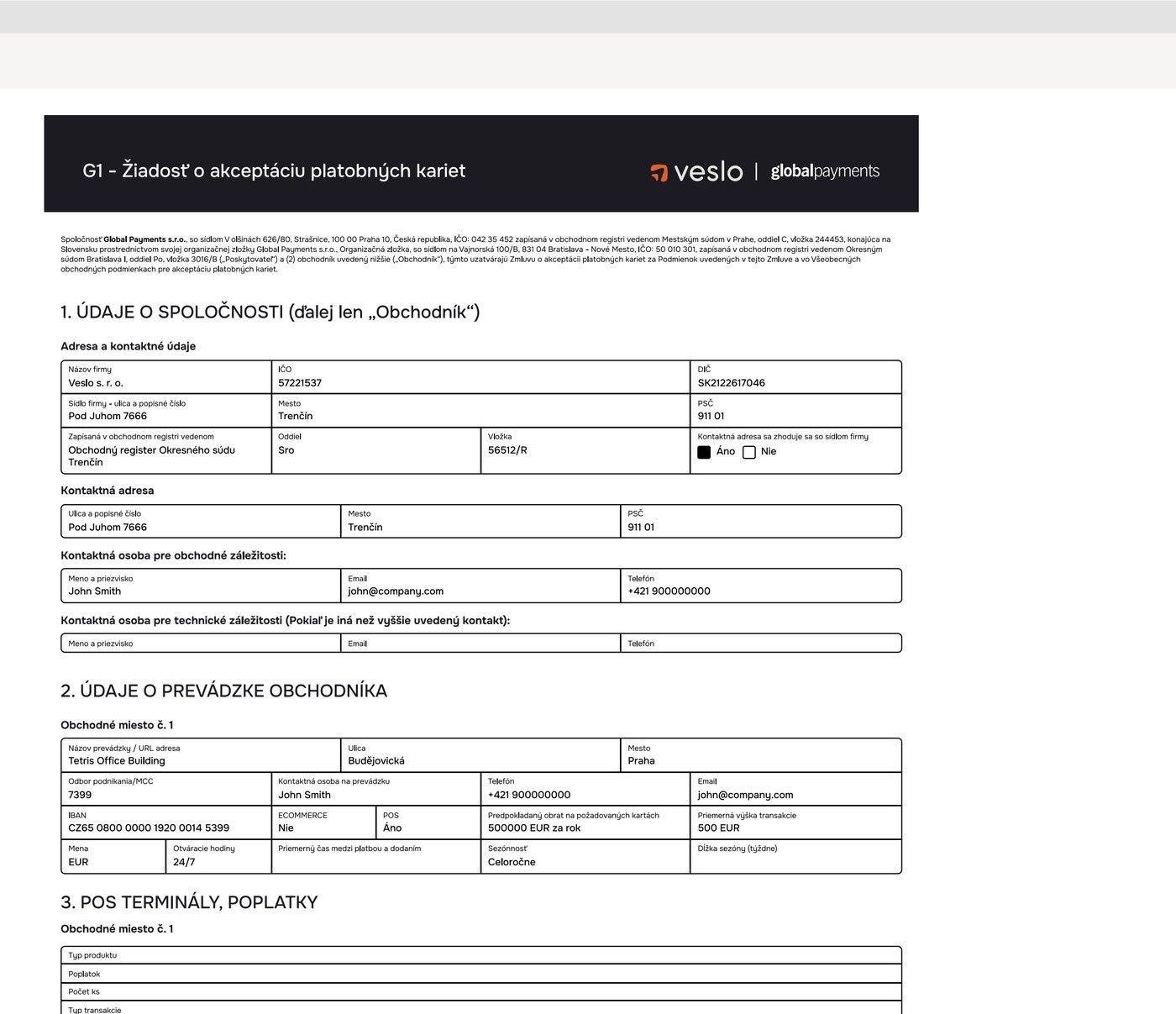
app.veslo.io/onboarding · step 1 · contact
Merchant onboarding — step 1, contact
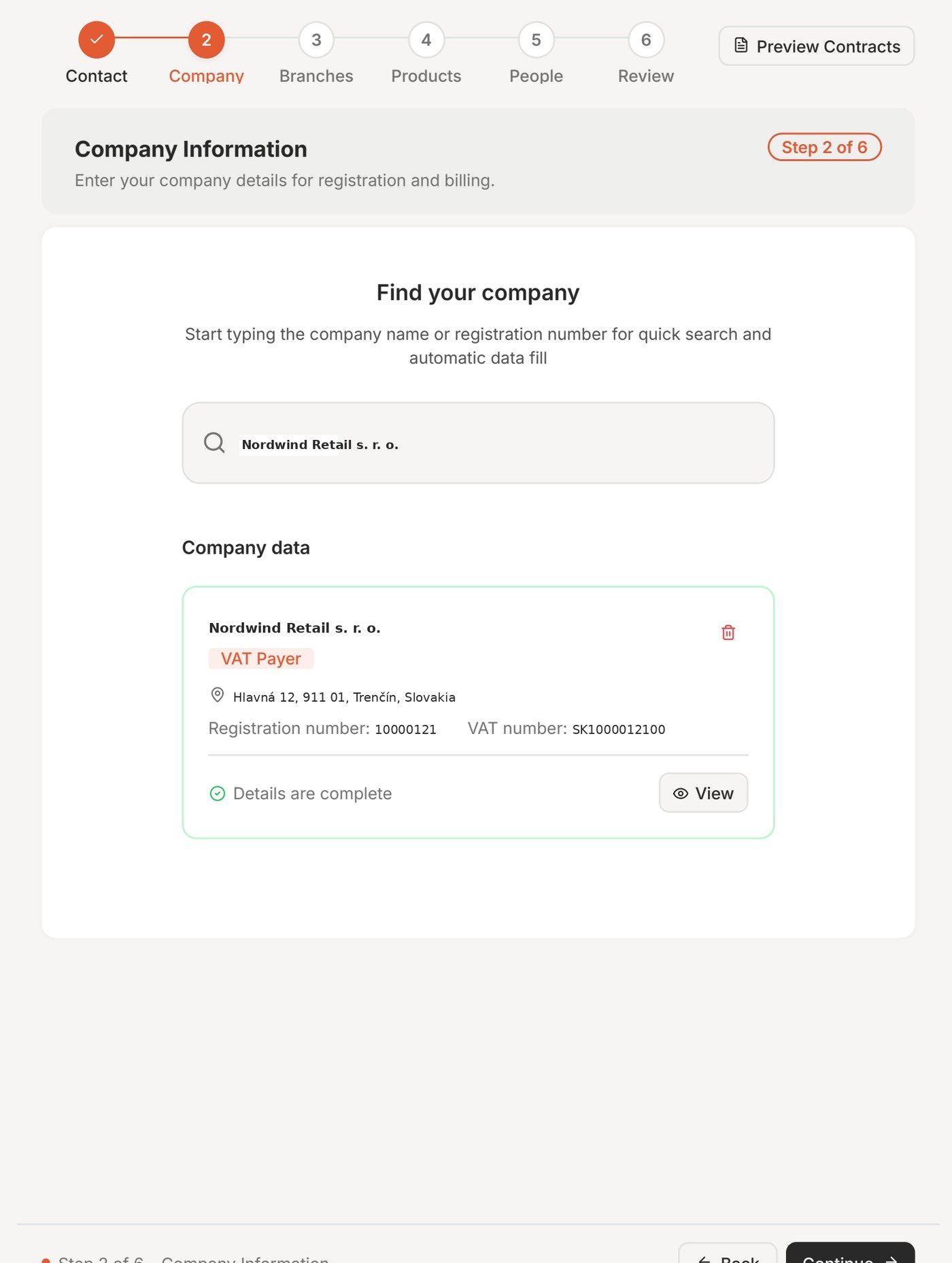
app.veslo.io/onboarding · step 2
Company lookup in the business registry
03

A link the merchant can finish alone

Send a public self-service link and the merchant completes the application without anyone from your team in the portal — or run the same flow as a guided in-portal wizard. Same data, same contract, either way.

04

Live registry lookup

The merchant types a company name; we pull the rest from the national business registry. Companies and sole traders alike.

05

Your team can take it over

If a merchant stalls halfway through, your team picks the application up remotely and completes it.

06

Onboard once, provision many

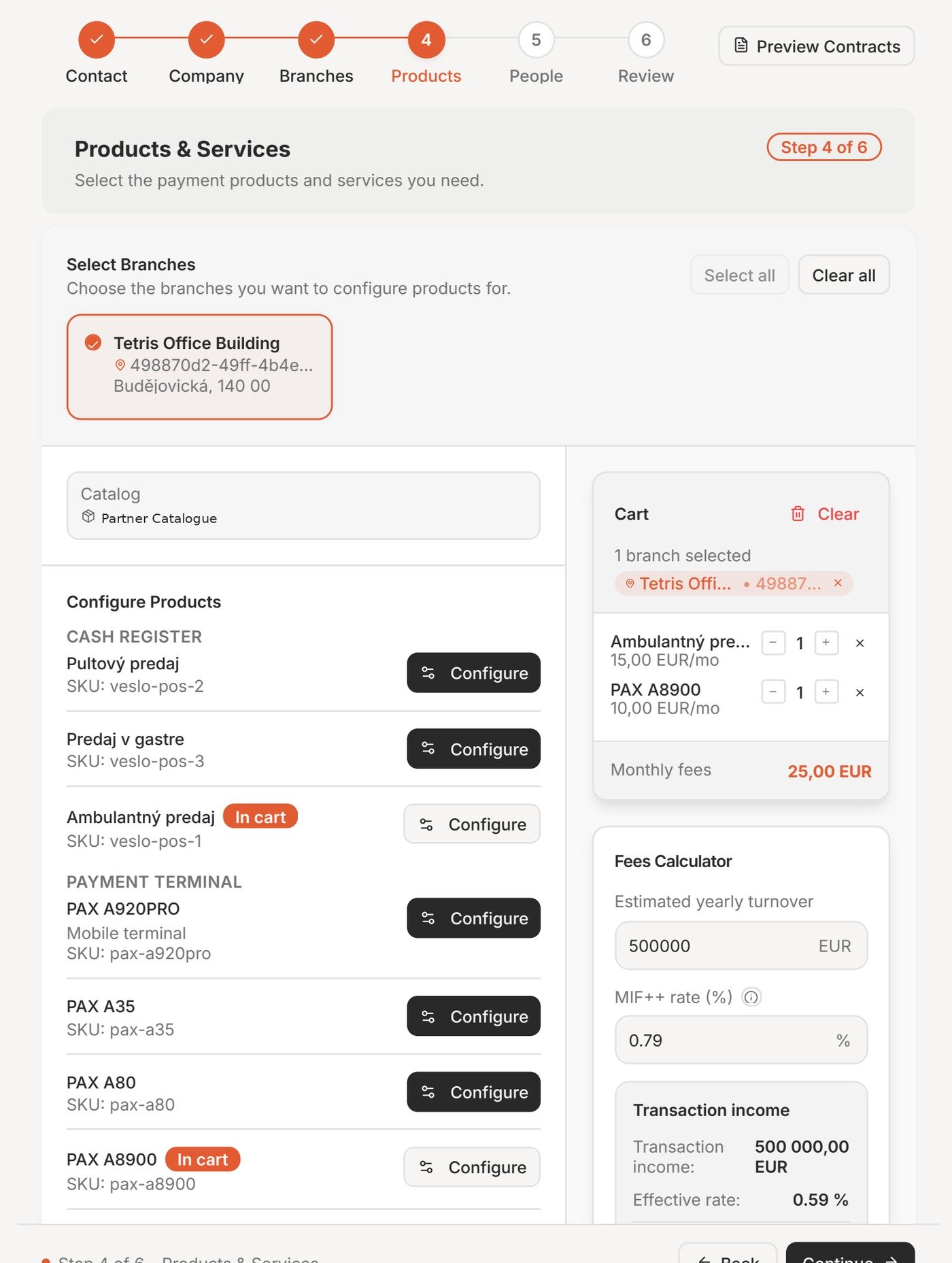
One sign-up provisions every product the merchant ordered — terminal, POS, fiscalisation, services. Nothing is asked twice.

07

The contract isn't only about cards

The contract is generated from a template, signed electronically and filed — with resend, reversal and a full audit trail, and a signing pipeline each ISO can switch on or off. Prices come from the product catalogue, so change a price once and every new contract picks it up.

Card acceptance is only one part of it. Because the data is already on file, adding a product later is an activation, not a second onboarding.
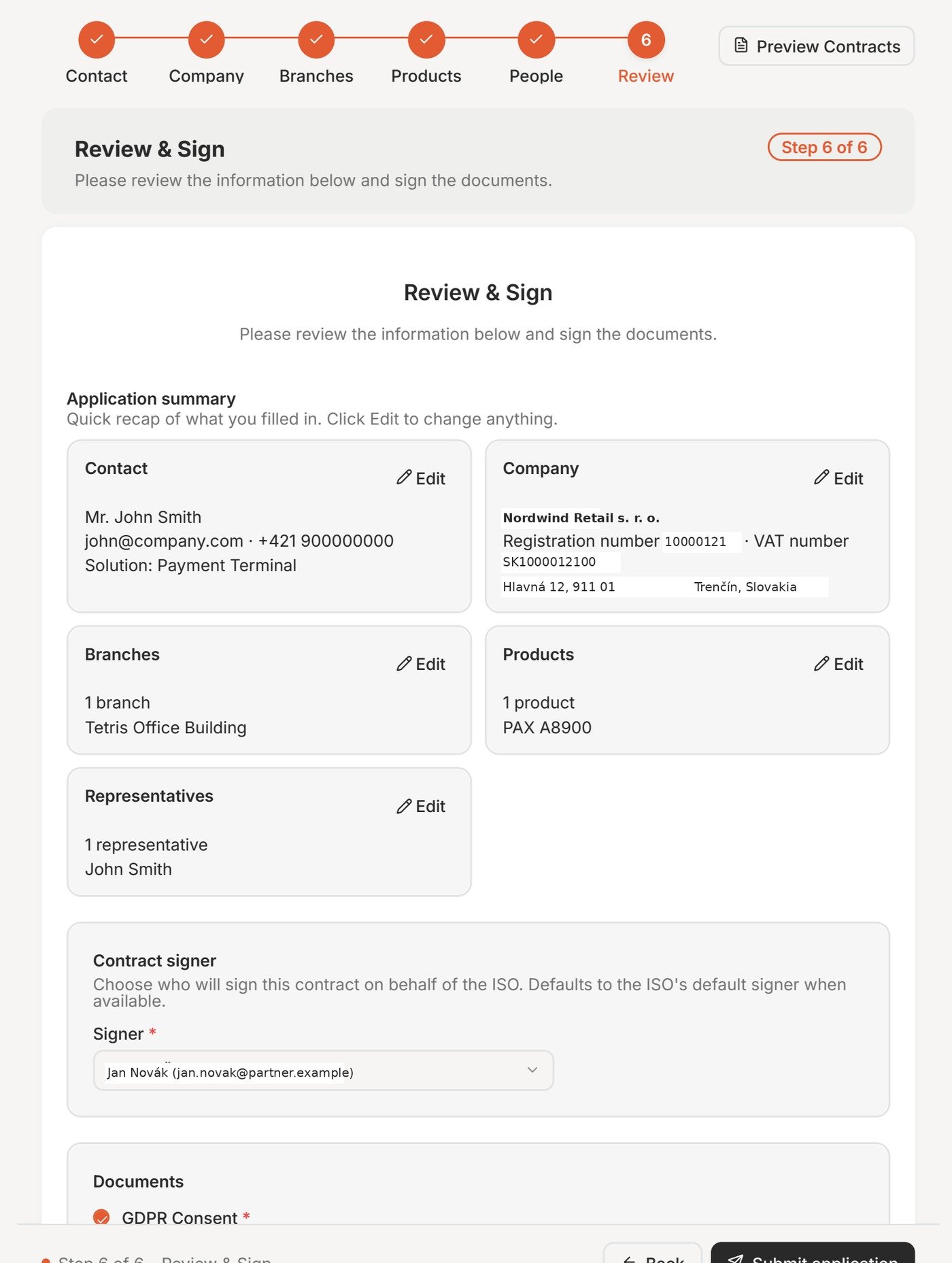
app.veslo.io/onboarding · step 6
Review and sign
app.veslo.io/onboarding · step 4
Products, fees and cart
app.veslo.io/onboarding · contract
Auto-generated contract

Adding a product later is an activation — not a second onboarding.

Because the data is already on file.
// Platform · Portfolio

Four portals.
One record of the merchant.

Vendor, ISO, partner and merchant each get their own surface — reading and writing the same data, under one permission model.

ISO portal

The operating cockpit — merchants, branches, devices, contracts, acquirers, catalogues, teams and profitability in one place.

Run a whole merchant portfolio from one place.

Partner portal

A sub-partner's own book of business, plus its API keys, webhook endpoints and delivery history.

A partner manages its own merchants and its own integration without asking us.

Vendor portal

The master product catalogue: product types, categories, packages and discounts.

Define the product once and every ISO sells from the same source.

Merchant portal

The merchant's own view — company details, users, documents and contracts, branches, devices.

The merchant self-serves instead of emailing support.
01

Profitability you can act on

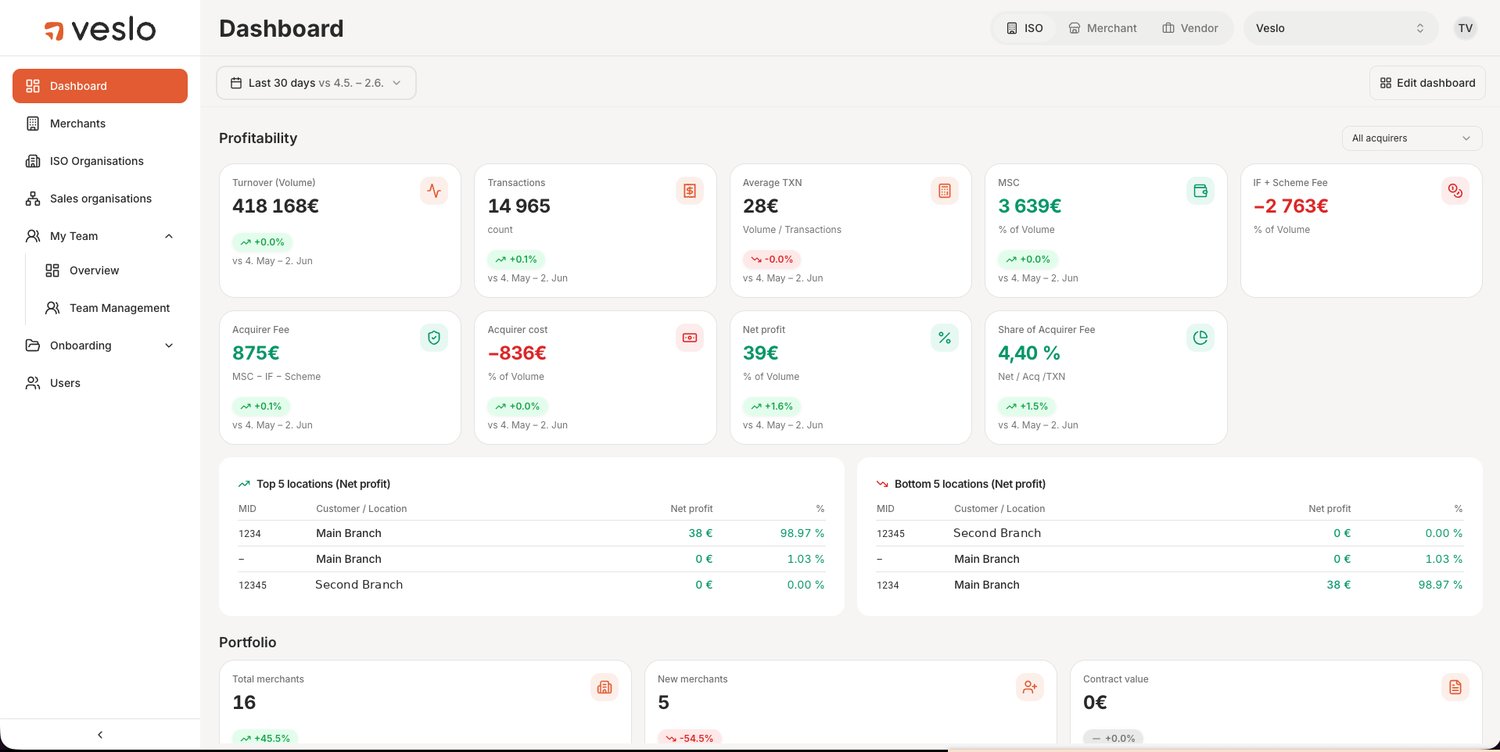
Turnover, transactions, MSC, interchange, acquirer cost and net profit — per portfolio, per acquirer and per MID. Not a monthly export: a live read-model fed by change-data-capture, so asking questions never slows the platform down.

02

The pipeline sits on the same platform

Deals, contacts and organisations with a pipeline dashboard and deal health notifications. You sell on the system you deliver on, so a won deal becomes an onboarding without leaving the tool.

app.veslo.io/dashboard
Portfolio dashboard with profitability
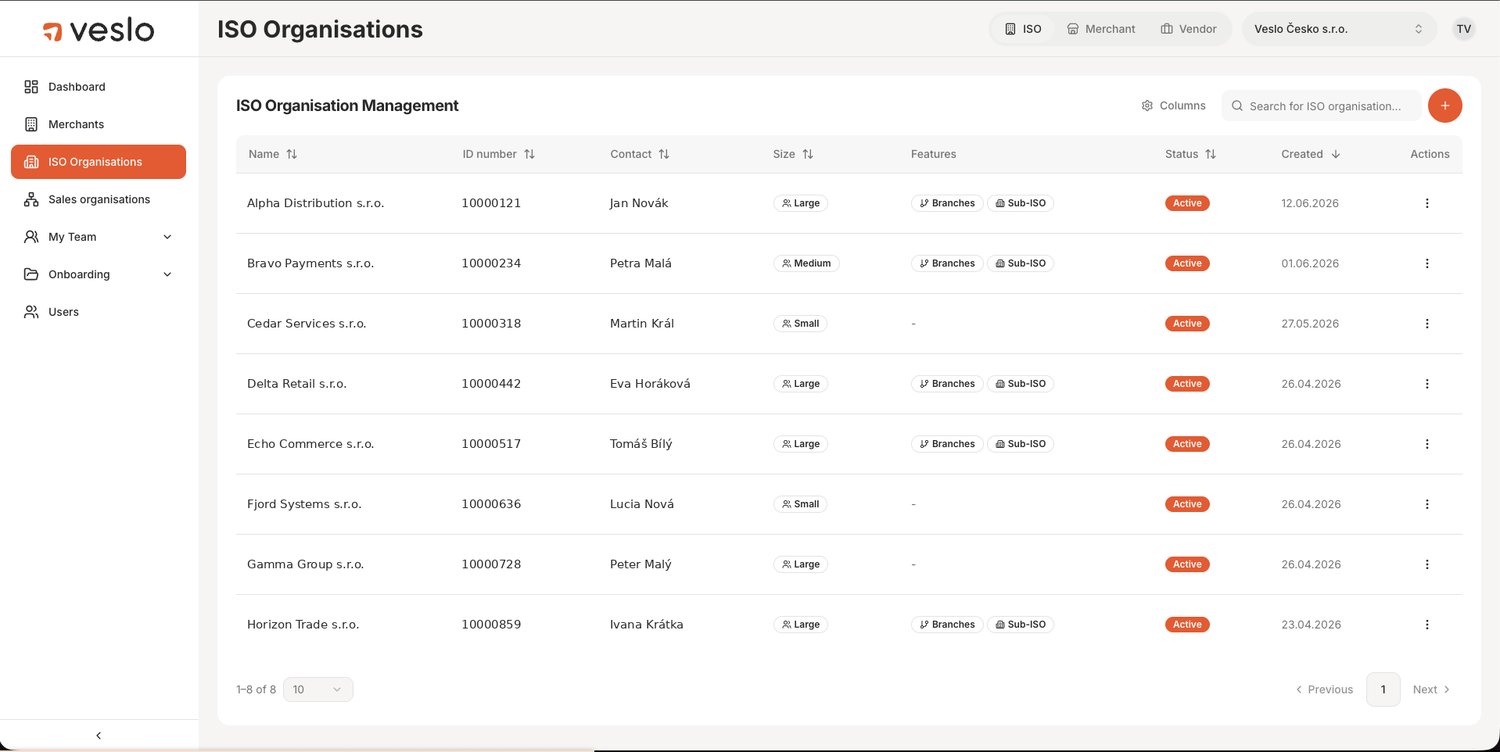
app.veslo.io/organisations
ISO organisations and sub-partners
03

Multi-level partner hierarchy

Vendor → ISO → sub-ISO → partner → merchant → branch. Roles are per-resource and per-possession — own versus any — with default roles per organisation type, so an audit finds an answer instead of a spreadsheet.

04

Teams, targets and what they're worth

Sales reps, technicians, support and managers with KPI fulfilment, plus an asset and subscription register that knows what every merchant actually has — and what they don't yet.

A sub-partner is a row — not a second deployment.

The hierarchy lives in the data model and in the permissions.
// Platform · Fleet

Ship the hardware.
Never chase it.

Pairing, activation, firmware and health for every terminal in the field — without visiting one.

01

Pairing, activation, reactivation

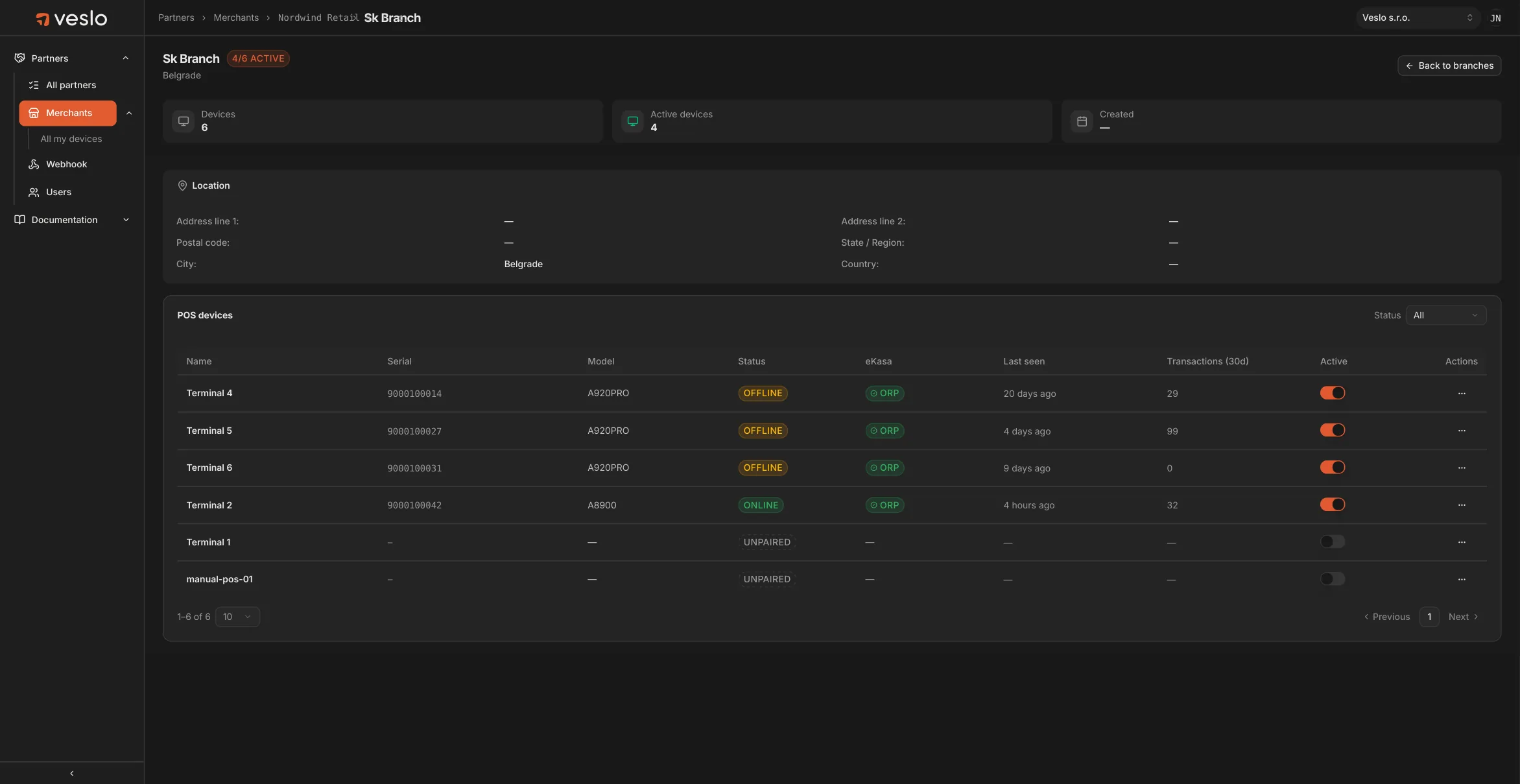
A device is paired to a branch and activated from the portal. Reactivation after a swap is the same flow — no engineer, no support ticket, no serial numbers in a spreadsheet.

02

Firmware and versions you can see

Fleet inventory with firmware and application versions per device, plus remote configuration. You know what is running in the field before you decide to change it.

app.veslo.io/devices
Device and partner management
03

Veslo Pulse on every terminal

The self-service terminal software: card and cash, a launcher, a foreground service that restarts on boot, offline cache, circuit breaker and health checks. It survives reboots and outages because the shop cannot wait for the network.

04

Assets and subscriptions, per merchant

What hardware and software each merchant has, subscription size and validity, and monthly used-services reporting — so billing matches reality.

We find the broken terminal before the merchant calls.

Health telemetry from every device, with alerting thresholds and automatic incidents.
// Platform · Compliance

Fiscalisation is local.
Your product doesn't have to be.

Every market has its own rules. We build and maintain fiscalisation in-house, country by country — and deliver it as an API, so it works for your software too, not only ours.

01

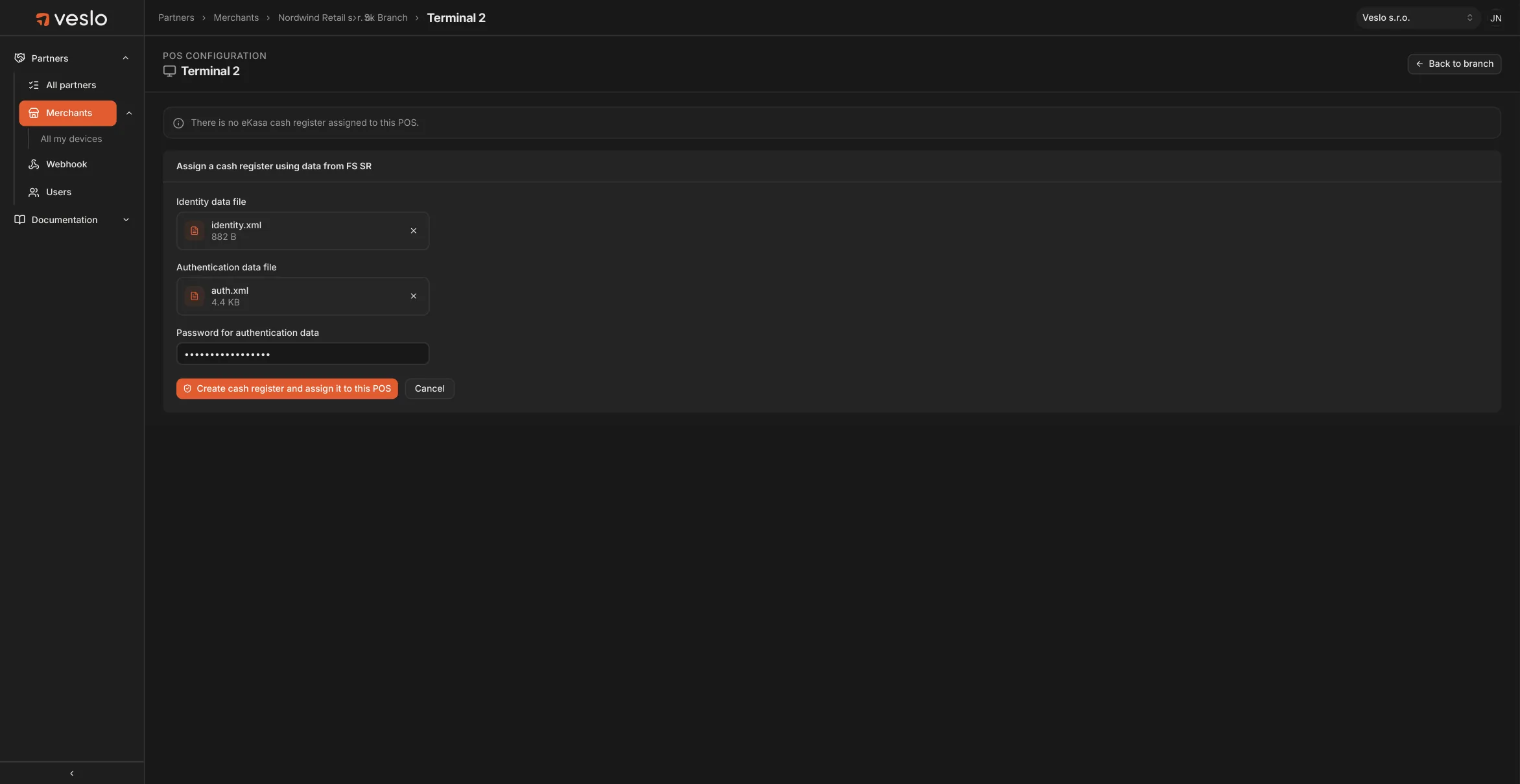
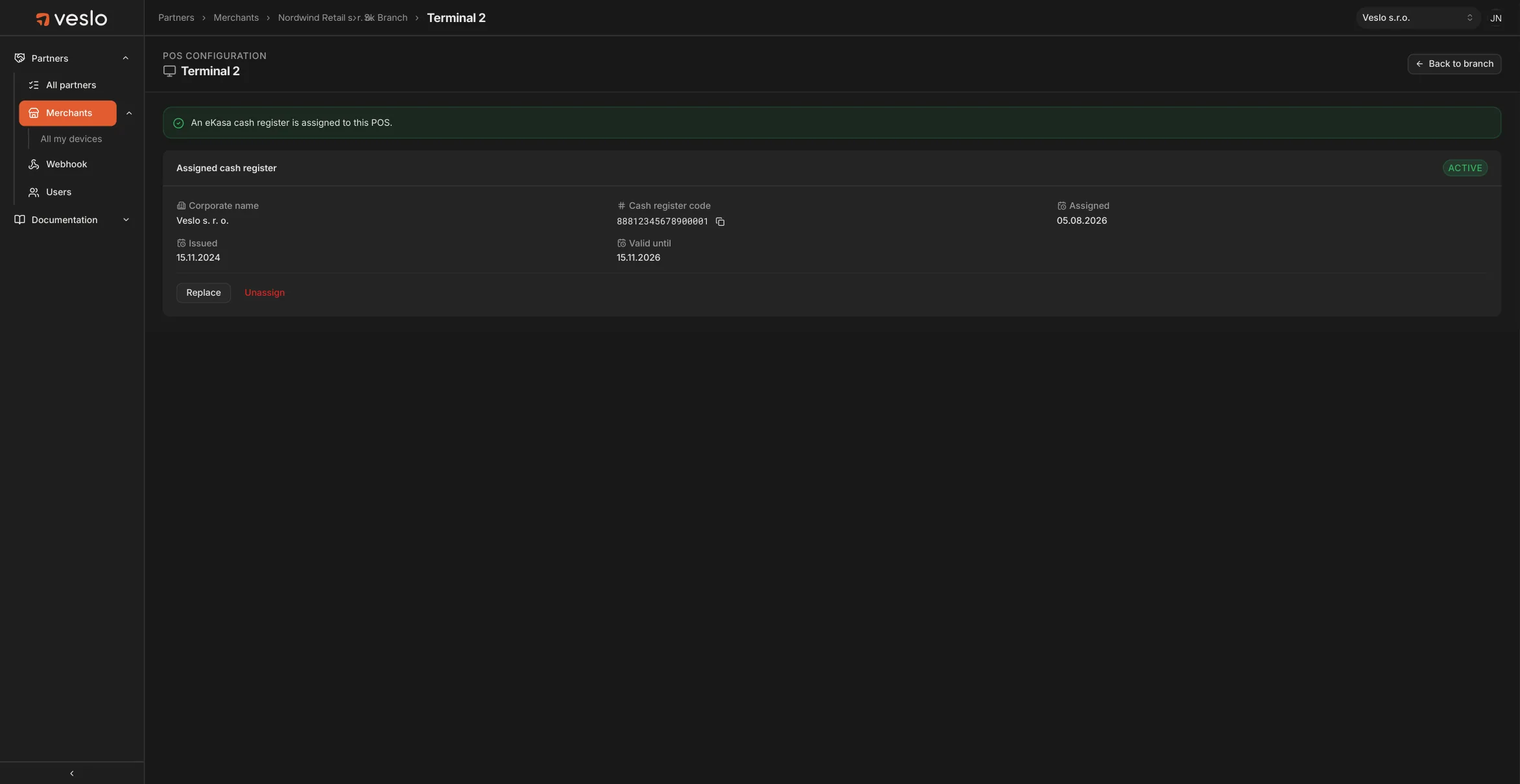
Slovakia — eKasa

Fiscal registration of every transaction, on the device and on our side, with offline and retry handling for the moments the connection is not there.

02

Czechia — EET 2.0

Per-merchant activation, the Czech receipt format and the same offline and retry path. One product, sold legally in a second market.

03

Or your existing local solution

Where a proven local fiscalisation already exists, we integrate it instead of rebuilding it. The market decides, not our roadmap.

04

Delivered as a service

Fiscalisation reaches you through the Integration Hub as an API — usable with or without the rest of the platform, if that is all you need from us.

Every sale is fiscalised without the merchant thinking about it.

On-device and service-side, with offline handling and retry.
// Platform · Integration

Your system learns
what happened. Without asking.

Event-driven by design: every card tap and every fiscal action fires an event you can subscribe to — no polling, no nightly export.

01

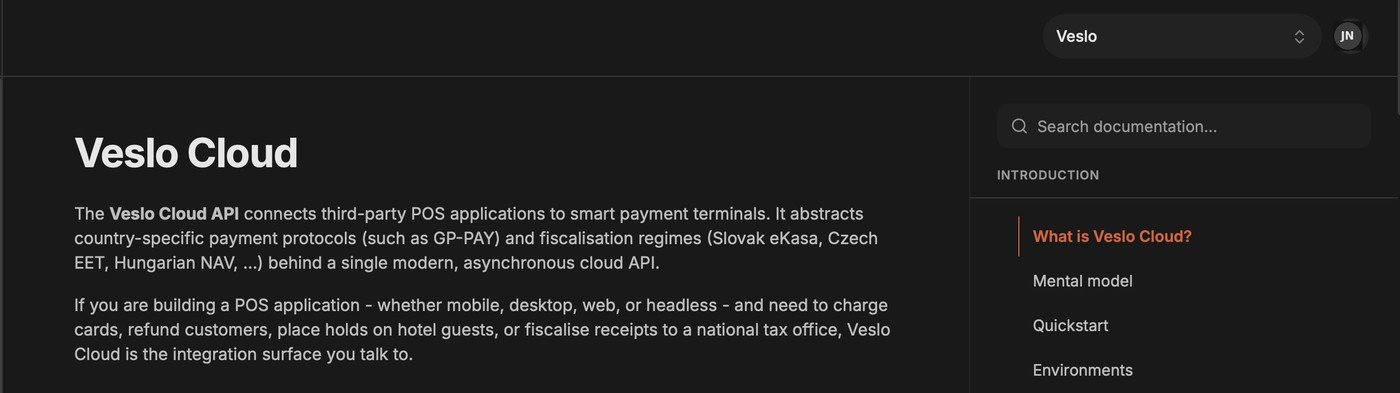
Public API and developer portal

An integration API for third-party systems, with documentation, a sandbox and API keys. A cash register or an ERP vendor integrates payments without becoming a payments company.

02

Webhooks that don't lose events

Subscriptions managed from the Partner portal, durable delivery with an outbox relay and retry, delivery history and replay. If your endpoint was down, the event is still there.

api.veslo.io/logs
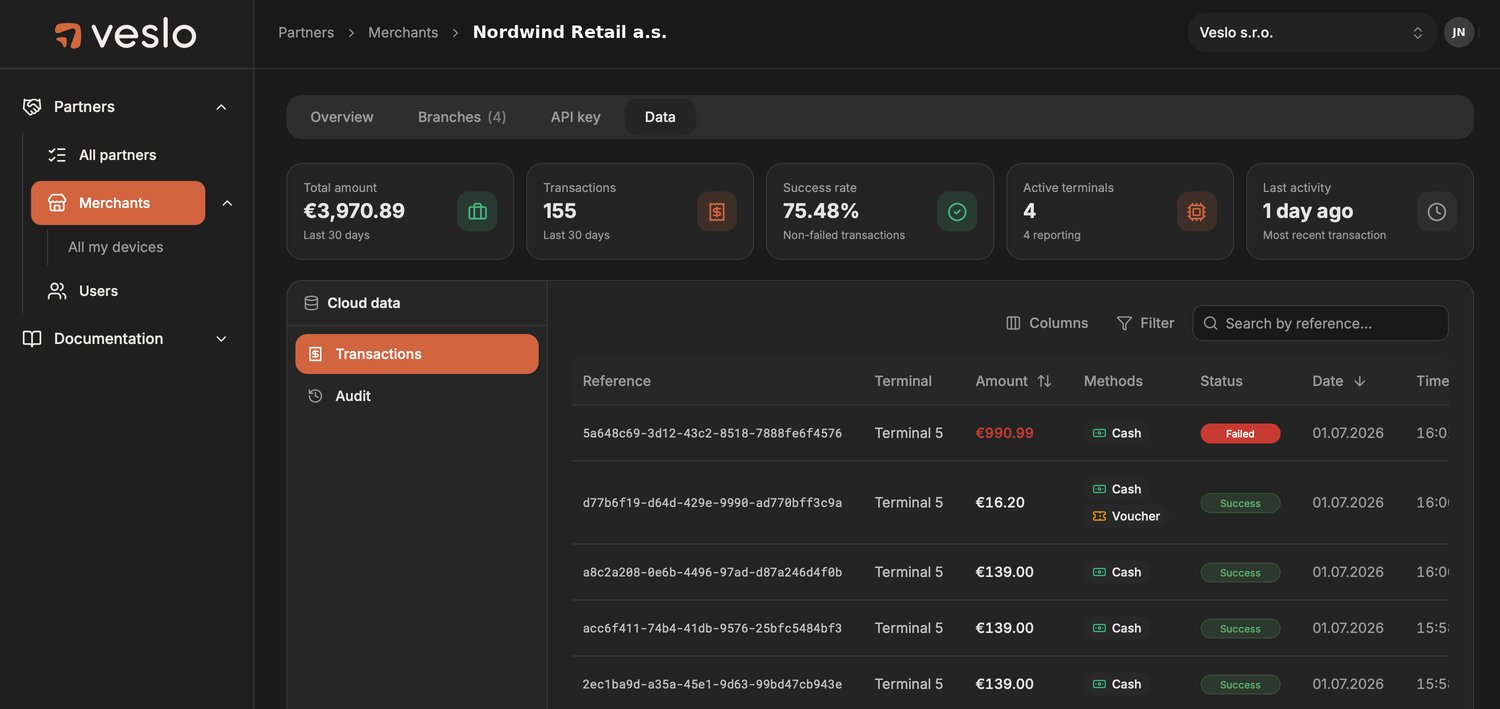
Transactions and API logs
partner.veslo.io/docs
Veslo Cloud developer documentation
03

Live streams

Server-sent transaction streams and device WebSocket channels — follow a payment as it happens, not after the fact.

04

Cloud-to-edge bridge

A cloud application securely triggers actions on the local device: card payment and fiscalisation managed from the cloud, with no local integration on the merchant's counter.

05

Veslo Auth and SDKs

Sign-in, sessions, tokens, account linking and account selection across organisations, with client libraries for TypeScript and Android.

06

Permissions that survive an audit

Per-resource, per-possession access — own versus any — with default roles per organisation type, shared by every API surface.

One identity across every portal and application in the chain.

Veslo Auth, with SDKs for TypeScript and Android and documentation you can integrate against alone.
// Platform · Backbone

The part nobody asks about
until it isn't there.

Everything above runs on the same backbone — one device-facing service, one API contract, one place to operate it all. You never buy it separately.

01

Veslo Cloud

The device-facing backbone: pairing and activation, locations and terminals, transactions and their lifecycle, fiscal events, live channels and webhook dispatch with an outbox relay. Everything a terminal talks to, and the single record of what happened.

02

Platform APIs

Core, ISO, Partner, Vendor and Merchant services over GraphQL, each audience with its own API surface rather than a filtered view of one — bound by a shared permission model and strict backward compatibility.

03

System administration

Cross-tenant administration and configuration. One place to operate the platform across every tenant, instead of logging into each one to change a setting.

04

Notifications

Templated transactional email, mobile push and event-triggered rules. The right person hears about it without anyone watching a screen.

05

White-label theming

Your brand colours and logo across portals and applications, driven per ISO from the same hierarchy — so your customers see your brand, not ours.

06

Support desk

Ticket intake from the register, the mobile app, chat, hotline and messaging, linked to the CRM record with routing rules. Support requests arrive with the customer context already attached.

One backbone. Every portal, every device, every market.

A Postgres write store, asynchronous events, and a read-model that answers questions without slowing anything down.
// Get started

Launch your merchant business on Veslo.

Tell us about your portfolio — we'll set you up with a partner workspace and a demo.